




'I’m not what the media has portrayed me to be' — Sofia Gomez Villafañe on winning, criticism and life at the top of gravel racing
Behind the “villain” label is one of the most consistent winners in gravel racing, and a rider determined to let real-life interactions reshape her story


Some mornings in winter, Sofia Gomez Villafañe can ride for hours through Tucson and barely be noticed. The desert roads are full of cyclists — pros escaping the cold, retirees spinning along the bike path, locals squeezing in a quick loop before work. On rides like the Shootout, she’s just another cyclist in the pack. Yes, people recognise her, but she often gravitates toward the juniors, chatting with their parents, asking about school or upcoming races. Most of the time, the interactions are simple, friendly and unremarkable.
Which, if you’ve spent much time reading about Gomez Villafañe — or watching the film projects that follow the sport — that might come as a surprise. The version of Gomez Villafañe that sometimes circulates online, intense, relentlessly competitive, doesn’t always match the one people encounter in person.
"The people that know me," she says, “the people I actually interact with — they don’t hate me at all."
Over the past several seasons, Gomez Villafañe has become one of the defining figures of American off-road racing. Since committing fully to gravel in 2022, she has stacked victories at many of the discipline’s marquee events, including wins at Unbound Gravel, Big Sugar Gravel and the Traka. The results have established her as one of the sport’s most consistent winners and a perennial contender in the Life Time Grand Prix series that anchors the U.S. gravel calendar.
But dominance, particularly in a young and rapidly professionalising discipline like gravel, has a way of creating narratives. And for Gomez Villafañe, the one that has followed her is complicated.
Depending on who is telling the story, she can be portrayed as intense, hyper-competitive or intimidating. In the first season of Call of a Lifetime, the docuseries following the Life Time Grand Prix, Gomez Villafañe was cast — fairly or not — as something of a villain: the ruthless racer willing to say out loud what others might only think.
Ask her about that reputation, and she sighs.
"The list of names I haven't been called would be shorter," she says. "I've been told I take my job too seriously. I’ve been told I don’t know how to have fun. I’ve been told I’m a b*tch. I’ve been told I’m too competitive."
Then she shrugs.
"But, yeah, I am super competitive. I do take my job really seriously. It’s just not in the negative light that certain media outlets or film projects have made it out to be."
She admits the criticism hasn’t been easy to ignore.
"It’s gotten to me, that’s for sure. It forces you to look at yourself in the mirror and ask: Is there truth to this?"
Ultimately, though, she doesn’t think the answer lies in trying to correct the narrative from afar. Gomez Villafañe prefers instead to show up and do her job, whether on race day — when the game face is unmistakable — or during long winter training rides in Arizona, where it softens.
"I don’t think there’s a way for me to change people’s minds with film projects," she says. "I think it’s more meeting people in real life, in a real human setting, and letting them realise I’m not what the media has portrayed me to be."
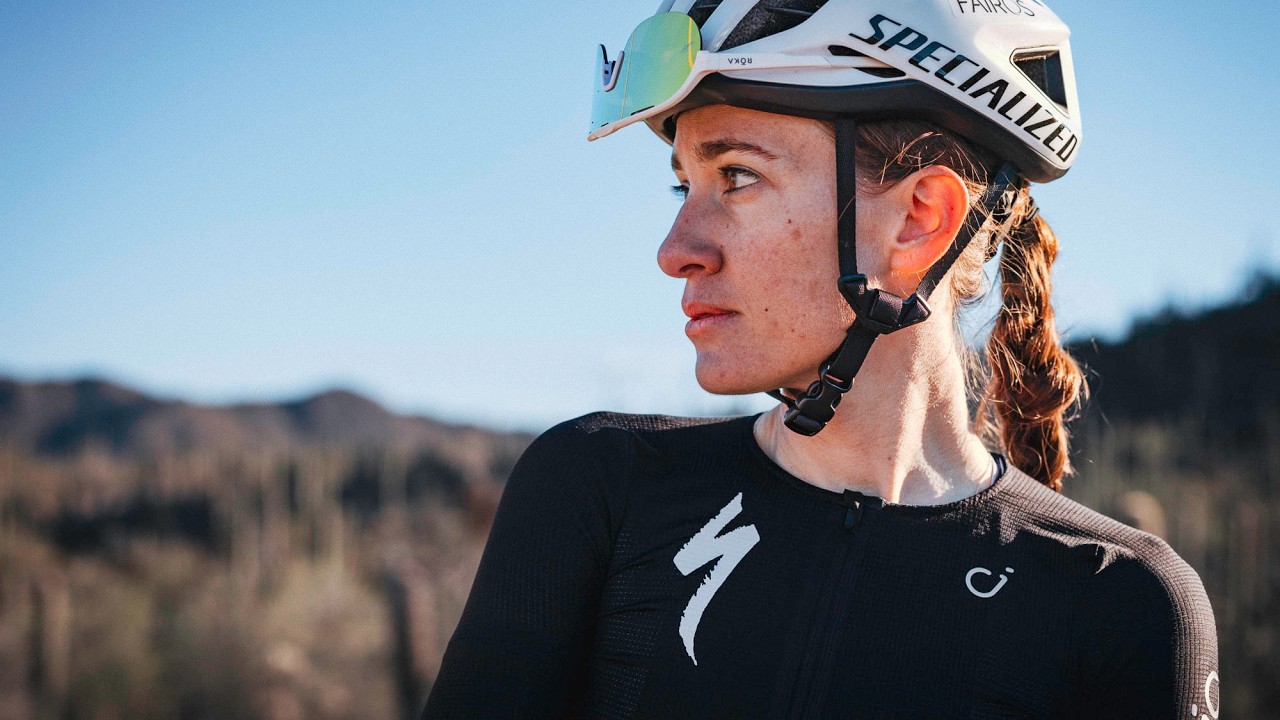
Gomez Villafañe’s intensity didn’t arrive with professional racing. Long before podiums and contracts and docuseries storylines, the 31-year-old had already developed a stubborn kind of independence.
Growing up, Gomez Villafañe was the kind of kid who rarely waited around for help. The fifth of six children, she was born in Argentina and immigrated to the United States with her family as a child. Independence, she says, came early. If she was hungry, she’d climb onto the kitchen counter and cook something herself. If she wanted to go somewhere, she figured out how to get there.
"When I was young, Friday would come around, and I’d call my parents and say, ‘OK, I’m going to this friend’s house tonight. Then we’re going to the lake the next day, then this friend’s parents are picking us up, and Sunday I’m doing this. And I’ll be home at 8 p.m.,’” she recalls. “I had everything planned out.”
After high school in California, where she raced cross-country mountain bikes in the NorCal League, Gomez Villafañe moved to Durango, Colorado, to attend Fort Lewis College. The plan was simple: race bikes and get a degree.
Durango made that plan possible. Between the college program and the town’s deep endurance culture, Gomez Villafañe found herself in an environment where taking racing seriously was the norm. For her, that mindset felt natural.
"To be the best bike racer I can be, I need to be really strong, really fierce," she says. "I need to carry myself with a lot of confidence because if you’re not confident when you’re lining up for a race, it isn’t just gonna magically show up when you start racing."
That mindset has followed her into every phase of her career, from collegiate mountain bike racing to the professional gravel circuit she now dominates. It’s visible in the way she studies courses, the way she trains, the way she races — aggressively and without apology. In a discipline that once prided itself on a more laid-back ethos, Gomez Villafañe’s approach has sometimes stood out.
But to her, the distinction between competitive and overly serious has always felt a little artificial.
"Of course, I try hard," she says. "These brands are giving me the opportunity to focus full-time on racing, and I don’t want them to feel like they’re not getting a return on that investment. It’s a job at the end of the day. I’m really lucky that my job is something a lot of people do as a hobby, but for me it’s about being the best athlete I can be."
That doesn’t mean she doesn’t enjoy it. If anything, the structure and focus are part of what she loves most about the sport. The discipline of preparing for a race, the satisfaction of executing a plan, the simple clarity of knowing exactly what the goal is on any given day — those things have always appealed to the independent kid who liked to have the weekend mapped out before it even started.
What she has learned, though, is that seriousness can be interpreted in different ways depending on who’s watching.
Some of that realisation came with experience. Some came with time spent seeing how the sport presents itself to the outside world. And some came simply from meeting people face to face: the riders and fans who show up at races, shake her hand, and realise the person in front of them isn’t quite the character they might have seen online.
In those moments, the narrative tends to fall away. For all the storylines that have followed her in recent years, Gomez Villafañe believes that the simplest version of herself is also the most accurate: She’s competitive. She takes her job seriously. She wants to win.
And outside the race tape, she’s also just another rider rolling through the Tucson winter sun, putting in the miles and saying hello to the people she passes along the way.
