




I made six tech predictions ahead of the Tour de France – which did I get right?
Leap Components and 3D printing dominated the tech at the Tour de France, but did our tech editor manage a clean sweep of predictions?

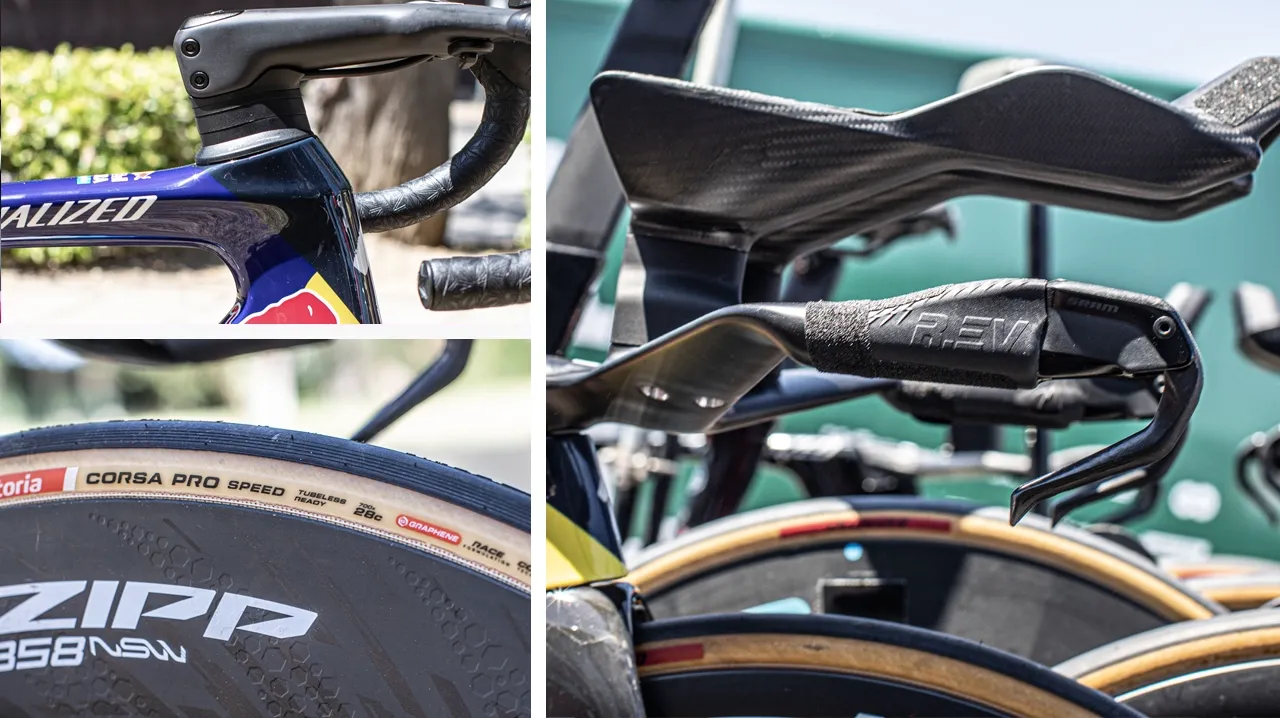
The Tour de France has come to an end, and what a race it turned out to be – both in terms of rider performances and the bikes and tech we saw along the way. We were on the ground in Barcelona, trawling the paddocks and team hotels in the quest of spotting new bikes and tech – you can read all about that in our TT and road tech gallery from the Grand Depart.
The biggest bike news was Remco Evenepoel's unreleased Specialized S-Works Shiv TT bike that stole the show at the Grand Depart in Barcelona. The Belgian had two versions of the new bike at his disposal – a camouflaged model and a regular team-liveried bike, the latter of which he steered to victory on stage 16's individual time trial. As we saw at the Tour Auvergne-Rhône-Alpes, Paul Seixas was also experimenting with options including his Van Rysel RCR-Pro prototype.
In terms of tech, I put myself out there and made six tech trend predictions based on the races I've attended and trends I've spotted emerge and develop over the past few seasons. While some were based on calculated forecasting, others were hunches I had due to this year's parcours and searing temperatures.
Let's get into the details.
More 3D-printed components and accessories – correct


This was an easy one. Having spent a large amount of time at the races this year, including Opening Weekend, 3D-printing has emerged as the biggest trend among teams and riders, with some riders going so far as to source solutions on their own. This creativity is a result of poor execution by bike manufacturers who sometimes don't take ancillary kit fit and finish into account.
Of all the products we saw on display, Netherlands-based company Leap Components took centre stage – particularly when it came to the SRAM-sponsored teams. The most widely used product was seen at the time trial stages, with the Aero Grip Blip Mount brake levers and TT Shift assembly used to neatly house the wireless blips, as seen on Tom Pidcock's Pinarello Bolide F TT bike. Some riders used Leap-branded housing, others removed the branding completely, while some personalised it with their initials (these are options given to the user by Leap Components).
We also saw Leap computer cradles and Aero Crankset Caps. Most teams were also using 3D-printed number flag holders on the seatposts.
The rise of stem spacers – correct


Another easy one to spot, based on the tech trends I've seen riders and teams employ over the past six months. In the past, the rhetoric around speed and aerodynamics pertained to slammed stems and front ends, but as sports science and biomechanics have progressed, more and more riders are seeing the benefits of adopting slightly more relaxed setups and embracing stem spacers.
WorldTour riders also change teams and bike brands, which means spacers are often an easy way of matching their bike fits. Some manufacturers have also updated the geometry of their bikes - such as the new Cannondale SuperSix Evo that now utilizes a 10mm lower stack - so some riders will need to use spacers to achieve the same position as before; the question over the necessity of the revised geometry is, of course, another topic.
At three-week-long Grand Tours, comfort is king and using a slammed front end can potentially result in compound fatigue. As a result, some riders are finding that raising their front ends improves ergonomics and allows them to maintain an aero position for longer by finding a sweet spot that balances aero and comfort.
While slammed stems were still employed (mainly by the old guard who refuse to cave), more riders are embracing stem spacers – but we're talking 10-20mm max.
Wider tyres are here to stay but 28mm still has a place – correct

Wider tyres are here to stay, but they don't rule the roost – especially at a race such as the Tour de France where every little marginal gain adds up. France is also known for its impeccable road surfaces, so teams could afford to utilise narrower tyres and benefit from the aerodynamic advantage.
From what I saw at the Grand Depart, the split was about 50:50 and came down to rider and team preference. Most teams were running 28mm for the time trial stages, and this ratio flipped slightly in favour of 30mm for the road stages, with some riders opting for 29mm. Overall, the split between road and dedicated time trial tyres was also pretty even across road and mountain stages.
Team UAE Emirates-XRG were seen using 28mm on the road stages, with Tadej Pogačar himself opting for 25mm tyres on his Colnago TT2 time trial bike. Speaking to a team mechanic at the hotel in Barcelona, he told me the 28mm Continental GP5000 TT TR tyres were chosen purely as an aerodynamic ploy.
A similar tactic was seen on the Cannondale Lab71 SuperSix Evos of EF Education-EasyPost and Pinarello Dogma F bikes of Pinarello-Q36.5 that used a mix of Vittoria Corsa Pro and Pro Speed. The Specialized Cotton TLR 30mm was the chief tyre choice employed by Red Bull-Bora-Hansgrohe and Soudal Quick-Step.
Return of the climbing bike – correct

Okay, maybe this one was a bit of a stretch because there were many of the best aero bikes used during the 21 days of racing – chiefly the Colnago Y1Rs and Cervelo S5.
Despite popular opinion, many of the Tour de France bikes aren't as light as you might think. Teams that have access to advanced all-rounders, such as the Specialized S-Works Tarmac SL9 or Cannondale SuperSix Evo, enjoy some substantial aero benefits within a build able to hit the 6.8kg weight limit. Others still have to choose between a heavier aero bike and a climber, with some still opting for the latter.
As one of the heavier bikes in the WorldTour, the Ridley Noah Fast of Uno-X Mobility was a veritable rocketship on the flats but a notable tank on the climbs with an estimated system weight of over 8kg for some riders. While Torstein Træen did ride the Noah Fast on his way to earning the yellow jersey, he and his team opted to ride an unreleased Falcon RS climbing bike in the high mountains.
Paul Seixas was also seen using an unreleased Van Rysel RCR-Pro in favour of his Van Rysel RCR-F aero bike, as the former is closer to the UCI weight limit of 6.8kg.
Vented aero helmets – correct

As I predicted, riders used aero helmets with improved ventilation this year. Specialized-sponsored teams had access to the all-new Evade 4 (which is claimed to be 2.4% cooler than the model it replaces), while UAE Team Emirates-XRG were riding unreleased Met Manta helmets with revised venting ports on the front.
To ensure they complied with UCI rules, EF Education-EasyPost adapted their Procen Air road helmets by removing the ear coverings on the flanks and visors, and pairing them with regular sunglasses. The Procen Air is known to be one of the fastest helmets in the WorldTour, and is underscored by three central vents on the top section.
We also saw Decathlon CMA CGM's Olaf Kooij wearing a Van Rysel RCR-F aero helmet with a galaxy mirror finish for improved peripheral vision in the sprint lead. Gimmick or not, Kooij managed to negotiate the chaotic lead-out and win stage 5's bunch sprint. While it appears to possess the same design as before, it's also one of the few dedicated aero lids that prioritises ventilation.
Faster, cooler fabrics and rider kit hacks – correct

This was a tougher one to spot than bikes, helmets, and accessories, as picking out new fabrics requires a keen eye and up-close examination. A few teams, however, were running new fabrics and skinsuits that combined aerodynamics with cooling properties.
Soudal Quick-Step's Tim Merlier used an unreleased Castelli skinsuit that bagged him three stage wins before abandoning the race on a mountainous stage 15. Inside sources tell us it's the same design as the suit he wore to three victories at the Giro d'Italia and that it 'comes alive at speeds of over 80km/h' – not your typical sprint speeds... It also uses a lightweight body-hugging fabric that improves ventilation and would have helped the Belgian in the scorching temperatures of weeks one and two.
Mathieu van der Poel was also using a new Kalas skinsuit. Dubbed 'Project Verano', the suit is reportedly designed for thermal management in the hottest temperatures, while still prioritising aerodynamics. The Dutchman won two stages in the skinsuit: stage 9 and the final stage on the Champs-Élysées.
