



Our feet aren't changing shape, so why are cycling shoes getting wider?
A new chapter is opening up for the once notoriously narrow cycling shoe


Change is afoot, cycling shoes are getting wider. Brands such as Bont and Lake may have offered wide fit options for years, but Sidi, an Italian brand infamous for its narrow-fitting shoes, has gone broader with its Millennium last. Another Italian brand, Fizik, has also introduced a wide fit option for at least four of its shoes, while its Vega Carbon race shoe boasts a noticeably wide toe box.
US-based Strong Feet Athletics has taken things a step further with its aptly named Leviathan model, a ‘barefoot’ cycling shoe so wide you’d imagine only a clown could fall in love with it. Yet, for the team behind the brand, foot comfort, performance and health are no joke.
Are feet getting wider?
An apparent reason why brands would want to introduce wider footwear is that their customers are developing wider feet. But there’s scant evidence to suggest this is true, partly because until recently, with the advent of 3D scanning, it wasn’t possible to gather accurate, reliable data in the volume required.
“The foot has grown in length over time, yet this is not proportionately related to an increase in width,” says Dr Helen Branthwaite, Chief Clinical Advisor to the Royal College of Podiatry. “Data around foot anthropometrics is dated, and gives no indication that the foot breadth of our population is increasing.
"Data around foot anthropometrics gives no indication that the foot breadth of our population is increasing"
Dr Helen Branthwaite, Chief Clinical Advisor to the Royal College of Podiatry
“Often, footwear is still manufactured on lasts dating from the 1900s. The future around 3D scanning, and personalised or modified last formation from digitisation, is providing a better fit along with new materials that not only consider the need for performance, but also look at the comfort of the sports performer.”
We do know that foot size varies significantly among regions and genders. An analysis of 1.2 million foot scans in 2019* showed that, proportionally, male and female Asian customers have significantly wider feet than European and North American customers, who have very similar mean widths. However, European customers have significantly higher insteps than North Americans.
Braithwaite adds that arch height, which influences the volume of a shoe through instep dimensions, is often proportionate to length in footwear manufacture; yet, a recent study has found no correlation between the two.**
Anecdotally, there also appears to be some truth in the perception that Italian footwear brands, at least in the recent past, favoured narrow shoes – perhaps for aesthetic reasons – despite Italians generally having regularly proportioned feet.
As Braithwaite points out, new technology, in the shape of 3D scanning, is providing footwear designers with real insights into how our feet interact with shoe lasts, so it’s likely that, due to the globalisation of trade, brands are both tweaking existing lasts and introducing new ones to ensure their products appeal to the, ahem, widest possible market.
But that’s not the whole story, as ever with cycling, this trend is as much about performance as it is comfort, two qualities that are inextricably intertwined.
The argument from the world of ‘barefoot shoes’ is, in short, that most of the shoes we see on the high street have been influenced more by fashion than foot shape. This niche of shoe design aims to provide shoes that follow the natural shape of the foot, which could (in theory) see toes with more room to splay, resulting in a wider shape over time.
Wide is the new narrow
It’s essential to distinguish between a last that’s broader to accommodate wider feet, and a more regular width last that has been subtly widened for improved performance.
“As well as our domestic market, our products have to appeal to a global market, including cyclists in Europe, the US and Asia,” responds Alex Locatelli, Product Manager, Fizik, when I ask him why the brand has, quite literally, broadened its range.
“But this is a complicated matter that requires a multi-angle approach, so let’s distinguish between power generation and power transfer,” says Locatelli. “Most recent studies in biomechanics suggest that well-spread metatarsals, with all bones contacting the footbed, are optimal for power generation.
“However, if space within the shoe is narrowed to the extent that the metatarsals are arched, reducing contact with the footbed, then output potential is compromised.”

Fizik Vento Omna Wide insole (bottom) shows the greater width vs one from a pair of Fizik Mechanism PNS shoes
In simple terms, it’s now accepted that to generate power effectively, the foot must be able to spread freely in the metatarsal area. This is the part of the foot composed of the five slender bones that connect the midfoot to the toes, essentially from where we press on the pedal through to our toes. The issue is that, until relatively recently, cyclists preferred narrow, tight-fitting shoes, believing that their power would be transferred more efficiently.
“To a certain degree, they were correct,” acknowledges Locatelli. “However, up until a few years ago, the materials used to make cycling shoes had more elasticity, so it made sense that the less material used, the less elongation, therefore the less power dispersion, especially from the 2nd to the 4th quadrant of the pedalling phase. These are the reasons why we had narrow shoes with low toe box volumes.”
Modern fabrics, such as Fizik’s Aeroweave mesh, are highly resistant to stretch, allowing the foot to be wrapped more naturally, without the levels of tightness typically associated with traditional cycling shoes. This has enabled Fizik’s designers to enlarge the Vega’s toe box, improving comfort and power generation without jeopardising power transfer.
What about heel lift? Is that more prevalent with stiff-soled, wider shoes? “Usually, the heel area is no wider in a wide-fit shoe than it is in a regular-fit,” Locatelli reassures me. “Heel slip is more likely caused by outsoles that have a reduced heel-to-ball drop if the heel shape is not designed well in terms of material, or if poorly manufactured.”
I also ask Locatelli about the ritual of tightening Boas just before a sprint. “Fizik invests a lot of time in research, including analysing data from 3D scans. It’s common to see this behaviour for sure, but we couldn’t perform any test that demonstrates that overtightening shoes results in an increase in expressed watts. So, I can only ascribe that behaviour to a heightened sensation of feeling ‘at one’ with the bike.”
Barefoot shoe wearers need cycling to catch up!

Lake's CX201 shoes are a unique offering on the market in being genuinely 'foot shaped'
Cycling Weekly's Digital Editor, Michelle Arthurs-Brennan, is a barefoot shoe convert, and thinks that cycling brands need to catch up...
I’ve always had feet shaped like spades: wide at the front, narrow at the ankle. You can imagine the endless arguments over school shoes whilst growing up. As an adult, I wore conventional, ‘normal shoes’ – up until the birth of my second child, when all that toe squishing seemed to catch up with me, in the development of a Morton’s Neuroma between my third and fourth toes. Many physio and podiatrist sessions later, and I’m an adamant barefoot shoe wearer, on the way to recovery.
The unfortunate reality for my cycling is that, in addressing the injury by working on spreading my metatarsal heads (see 'toe spacers' and 'toe yoga'), my feet now feel horrendous in any shoe that doesn’t have a ‘natural foot-shaped’ toe box. The sentence in itself feels absurd, in that we’ve constructed a reality where shoes are not shaped like feet, but that’s an argument for another day.
There is, however, hope. I’ve been wearing Lake’s CX201. This shoe isn’t just ‘wide’, it follows the conventions of the Altra and El Naturalista shoes I now wear day to day. Sliding my feet into these for a first ride was a lightbulb moment, and, a relief.
There is width added all over, which is something Lake's own rep made me aware of. For me personally, this does mean there's more space at the ankle than I'd like, but the shoes could prove the perfect solution for a rider who needs extra space all over. I have a pair of Strong Feet Athletics en route for a test, too, but in the meantime, the Lake CX201 shoes have allowed me to ride in much greater comfort, and they remain a unique offering on the market.
Baring one’s sole
Despite the sizable changes on the inside, you’d be hard-pressed to identify these new-generation shoes from Fizik and Sidi based solely on their external appearance. Not so the Leviathan from Strong Feet Athletics, which, as the name suggests, is a giant of a shoe. Its wide, flat ‘zero-drop’ platform is similar in principle to the barefoot sports and leisure shoes we’ve grown comfortable seeing over the past couple of decades.
“Narrow shoes do not enhance performance; they interfere with it by distorting the natural shape and function of the foot,” Tyler Benner, founder of Strong Feet Athletics, tells me. “A proper cycling shoe must provide a flat, stable base to avoid distorting joint alignment, and it must also allow for a naturally wide forefoot where the toes, especially the big toe, can engage with the ground. These are not minor preferences. They are fundamental to how the foot works.
"Narrow shoes interfere with performance by distorting the natural shape and function of the foot"
Tyler Benner, founder of Strong Feet Athletics,
“A flat platform – zero drop – allows the foot to operate without distortion, preserving the natural stacking of joints,” continues Benner. “A wide toe box permits the toes to splay and load dynamically, which supports balance, especially under load. You don’t need one or the other. You need both, if your goal is to support the human foot in its natural, functional role – something most performance shoes still fail to do.”
I’m blessed with large, size 48 feet, but they are regularly proportioned – neither narrow nor wide. I’m rarely troubled by foot discomfort until I’m a good four hours into a ride, when my feet occasionally show signs of swelling. Should riders like me consider a wider fit?
“Yes,” says Benner. “Swelling is predictable over long distances, especially in heat. A shoe that accommodates this expansion without crushing the forefoot or forcing the toes together will maintain comfort and performance deeper into the ride. It’s not about ‘wide’ as a fit category. It’s about ‘foot-shaped’. A naturally shaped shoe with room for the toes, whether for wide or average feet, will almost always feel better by hour four than a traditional tapered design.”
I’m also curious to discover whether wider shoes tend to provide more volume by default for riders with a high instep.
“Not reliably. Width and volume are separate metrics,” confirms Benner. “A wide shoe may give you more space at the ball of the foot, but if the instep isn’t built up or adjustable, it can still compress the top of your foot. The best option for high-instep riders is a shoe that offers either variable closure or customizable volume zones, especially across the midfoot and arch.”
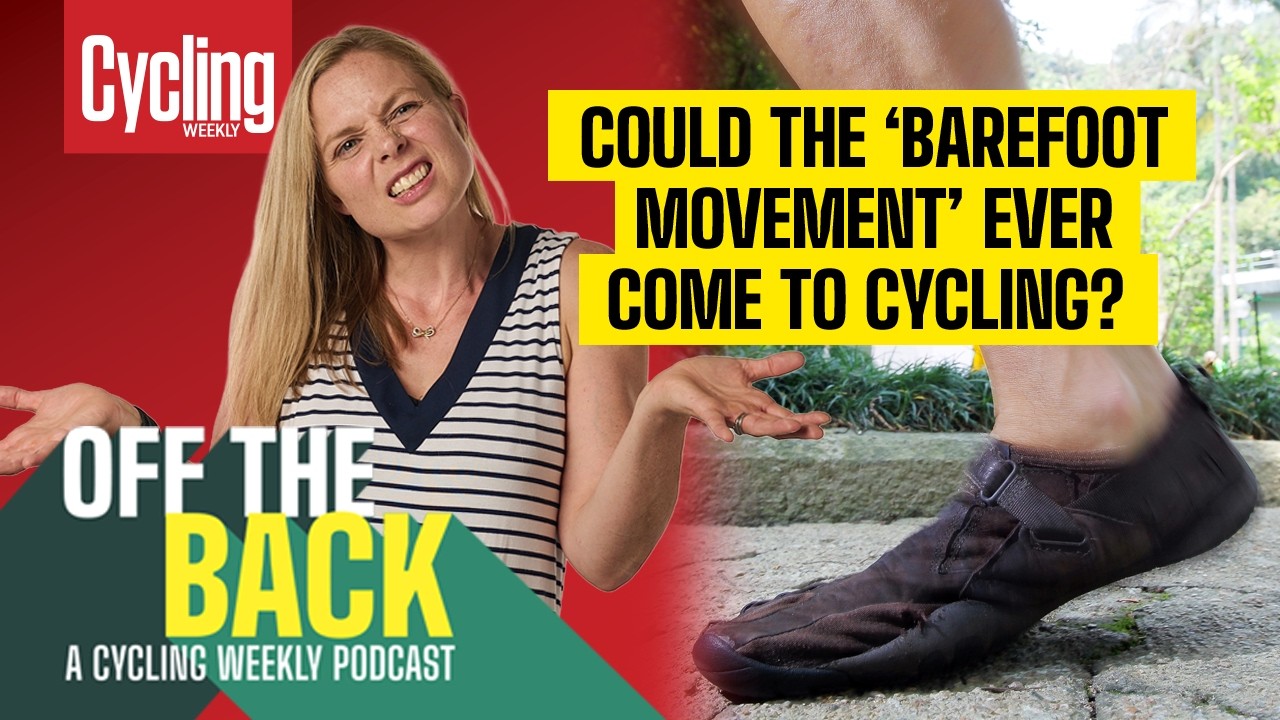
Listen: Cycling Weekly's Off the Back Podcast
Cycling Weekly explored the relevance of the barefoot shoe movement in a podcast, featuring The Foot Collective Guide Nicola Pike, former Head of Physiotherapy at British Cycling and founder at the eponymous Phil Burt Innovation, and owner of VeloAtelier and International Bike Fitting Institute (IBFI) President, Lee Prescott.
When asked why he is such an enthusiastic advocate of ‘barefoot’ cycling shoes, Benner points to the damage caused by the prevalence of sedentary lifestyles and poor footwear choices. Lifestyles and habits that perpetuate further bad choices, and distort the data relied on by footwear designers.
“There’s an epidemic of people with weak and weakening feet,” says Benner. “Most people change one to two sizes when they seriously begin to strengthen their feet. We need to understand what strong feet actually look like, and how footwear can better serve us because, unfortunately, the datasets we have are contaminated by decades of weak and dysfunctional feet.”
By happy coincidence, the increase in shoe widths is analogous to the recent explosion in tyre widths. Improved comfort is a key component of both trends, but there are also performance advantages. Some are directly related to comfort, while others are the product of a larger contact patch – footbed and tarmac, respectively.
If you’re still firmly shoehorned into the assumption that narrower is better, try broadening your outlook with some wider shoes. As datasets improve, so should fit, comfort and performance.