




Grand Départ to the Flamme Rouge and everything in-between: your guide to the language of the Tour de France
Watching or reading about the Tour de France can often feel like learning a new language, so we've done a little translation for you


If you've ever opened up Duolingo and searched for 'Tour de France', you have our sympathy. Picking up the dialect of bike racing is not unlike going back to school and is no overnight thing. Not only are there an abundance of words and phrases that you've probably never come across previously, at least in this context, many of them are also in French, especially at the Tour de France. If you're new to it, it can all be rather baffling.
We've put together this glossary of terms that you can save in your bookmarks to help you out while you're following the Tour de France, and next time a commentator tells you there's an echelon in the peloton you can nod sagely rather than going down the google route (again), or ploughing on in ignorance.
Arrivée
The end point of the race, or the finish line. The literal translation for the latter is ligne d'arrivée
Bidon
A water bottle, held on the riders's bikes by bottle cages on the down and seat tubes. You'll often see domestiques going back to the team car to load up with multiple bidons which they take up to their team leaders who get to sit in the bunch and not waste energy. Riders used to stuff them in their pockets and down their jerseys, some now have vests that hold the bottles. A bidon is also a prized possession of a road-side fan. As the riders discard their empty ones, spectators will do their best to grab them.
Breakaway
A rider or group of riders who have managed to jump away from the peloton (see below). Often this is a speculative move and unlikely to last all the way to the finish line, but for small teams in particular it's a way of achieving precious airtime for their sponsors. On occasions the breakaway does succeed, with lumpy days that fall between 'mountainous' and 'flat' often yielding the most success.
Bonk
When a rider comes to a virtual standstill because they have run out of energy. Also know as hitting the wall, or crashing, it's when a rider has depleted their glycogen stores and have no fuel left in the body to maintain anything more than a very, very slow, painful cadence. You'll rarely see it at the Tour de France as riders have chefs and nutritionists looking after their every need, and DS's in the car behind reminding them to eat and drink every 30 minutes, but it remains the scourge of the amateur cyclist who doesn't take enough food and drink with them on a ride.
Col
The word that usually appears in front of the name of a mountain, eg, the Col du Tourmalet, often shorted to Col. It actually means pass, as in the road that goes over the top of a mountain climb. Côte is used for smaller climbs, at the Tour, that's typically a category 4 or 3 climb
Commissaire
The official overseeing the racing and ensuring the UCI's rules are being adhered to by the riders and their DS's in the team car behind. There will also be technical commissaires whose job it is to ensure the UCI's technical rules and regulations are adhered to. Their work is done before a stage when bikes are weighed and or measured.
Coureur
Technically the French word for a runner. Coureur cycliste is the correct term for a racing cyclist that often gets shortened to just Coureur.
Directeur Sportif (DS)
The person behind the wheel of the team car behind the peloton. The DS is the manager on the road, providing support to their riders. This is both via the team radio (riders have earpieces in to talk to each other and the DS in the car behind) and in person when a rider drops back behind the peloton, or, when a rider in a break calls his team car up. To do this they go to the back of their group, put one arm in the air to alert the race referee who will call up their team car. Most DS's are former riders who are experienced at moving up through the line of cars behind a peloton, or passing a peloton to get to their rider in the break. There are strict rules about doing this, and DS's can be fined or kicked off a race if they break them.
Echelon
Not to be confused with peloton but not unrelated, this is when the bunch is forced to ride in a diagonal line across the road because crosswinds mean riders cannot find shelter directly behind each other like they usually would. Instead they shelter from the crosswinds to the side of each other, creating a line across the road.
However, this line inevitably has to end when it reaches the far side of the road, forcing riders out of the line – this is where an echelon becomes a key tactical device. The gaps created on windy days often mean the weaker teams can lose significant amounts of time.
Etape
French word for 'stage'. There are 21 stages in the Grand Tours
Equipe
Team. there are 23 teams taking part in the Tour de France. L'Equipe is a daily french sports newspaper launched in 1946. It is the successor to L'Auto, the paper whose editor first came up with the idea of a race around France to promote the paper. L'Auto was printed on yellow pages, hence the yellow jersey being worn by the leader of the Tour de France
Flamme rouge
Given that the finish line is usually called (perhaps disappointingly) 'the finish line' and requires no explanation, the flamme rouge, or red kite as it's known in English, feels like an appropriate place to sign off. Suspended from a gantry spanning the road, this is a key marker in the race which signifies one kilometre to go to the finish. On a long, arduous day most riders will be extremely happy to see it, but when it comes to sprint days, it's where the action really begins and the fast finishers prepare to earn their crust.
General classification (GC)
Often referred to simply as the 'GC', the general classification is the leaderboard showing which riders are leading the race overall. The leader will be the rider who has amassed the least time on aggregate across each of the stages, and they wear the coveted yellow jersey. The aim is to be at the top of the General Classification in Paris – the rider who achieves that wins the Tour de France.
Grand Départ
We might as well start here. A French phrase that translates as 'big start', it refers to the beginning of a Grand Tour and, in cases where it takes place in a country that isn't the usual host nation (such as Spain in this year's Tour), often refers to the entire three days spent in that country.
Grupetto
This Italian word refers to the group of non-climbers (or simply those having a bad day) that amasses on mountain days to pace each other up the climbs and ensure they finish the stage within the designated time cut. It's sometimes referred to as the laughing group, but while they're riding more slowly than the leaders, mountain stages are never easy for anyone, and you won't see that much laughing going on.
Hors-cat
The toughest category of climb in bike racing, and short for the French 'hors-catégorie', which essentially means 'beyond classification'. It usually refers to the biggest mountains with a challenging combination of length, gradient and altitude. Climb categories begin at 4 for the easiest, moving up through 3, 2, and 1 before reaching HC. Not all climbs on a stage will be categorised, but the big mountain ascents always are.
Leadout
When sprinters thank their teams after winning a sprint finish, they're often effusive in their praise; this is because they've enjoyed a good leadout – one of the most challenging, fraught and risky aspects of bike racing. Each team hoping to deliver a sprinter to victory will provide them with their own leadout – a line of riders charging ahead of them to the finish line, offering shelter from the wind and keeping the speed high.
Each rider will have their own job to do, with the first ones kicking in with perhaps 5km to go, and then pulling out of the line once their time is up and their legs exhausted. The final rider is the most important – called the 'leadout man' in men's racing, and delivers their charge to the 250m to go mark, hopefully in a good position to sprint for the win.

A Tour de France sprint finish in full flow
Mechanical
Short-hand for 'mechanical issue', this term is a catch-all for just about any bike-based issue that may befall a rider during the race. Usually signified by a rider standing at the roadside looking at their machine in dismay, these can range from slipped chains and broken gears (among the most common) to a broken frame (unusual) and anything in-between. There is also the good old puncture, although this would usually be referred to as such. Whatever the problem, a mechanical can often be attended to by the neutral service (see below).
Musette
Small bag handed up by team helpers in designated feed zones containing food and gels.
Neutral service
Provided by components manufacturer Shimano, the distinctive blue neutral service cars and motorbikes at the Tour de France provide spare wheels and bikes to riders who have been stranded by mechanical issues and are a long way from their team cars. As the name suggests, the neutral service is not affiliated to any particular team. It carries replacement wheels and bikes for many sizes and fitments but not all, and sometimes riders must simply endure a frustrating wait for their team car to appear.

The peloton of the Tour de France scythes through the countryside
Parcours
Another French word meaning the route of a bike race
Peloton
This one you'll hear a lot and, once again, it's French. It refers to the main body of riders in a race, which is often also called the 'bunch'. When all the riders are together, it's often simply used casually to refer to the race, but if there is a breakaway up the road it's also a useful way of denoting the main body of riders that are chasing behind, and if you're watching on TV you may well see a small 'P' for peloton in the top left corner, where the time gaps are shown.
Puncheur
A word mixing French and English to create a label for a rider that does pretty much what it says on the tin. These are the riders that pack a punch, usually denoting the ability to launch powerful attacks and even win on the smaller, steeper climbs – useful on the in-between stages that don't involve major mountains or flat finishes.
Rouleur
Another rider label, denoting a powerful rider with the ability to ride hard for long periods, typically on flat to rolling terrain. Mountains are usually hostile territory for them, where they'll often be found in the grupetto. But once things flatten out, they can put the lightweight climbers to the sword, and will often be found at or near the front putting in sterling work for their teams in chasing breakaways.
Sprint day / sprint finish
Theoretically, all days finish in a sprint, unless a rider wins alone. But if you see or hear a particular stage referred to as a sprint day, or that it's expected to be a sprint finish, it usually means that the riders are predicted to be all together at the end, with the very fastest power sprinters contesting the victory. This usually applies on the flatter stages; a hill or two mid-way won't usually change this, but one that comes near the end can really upset the sprinters' plans.
Sticky bottle
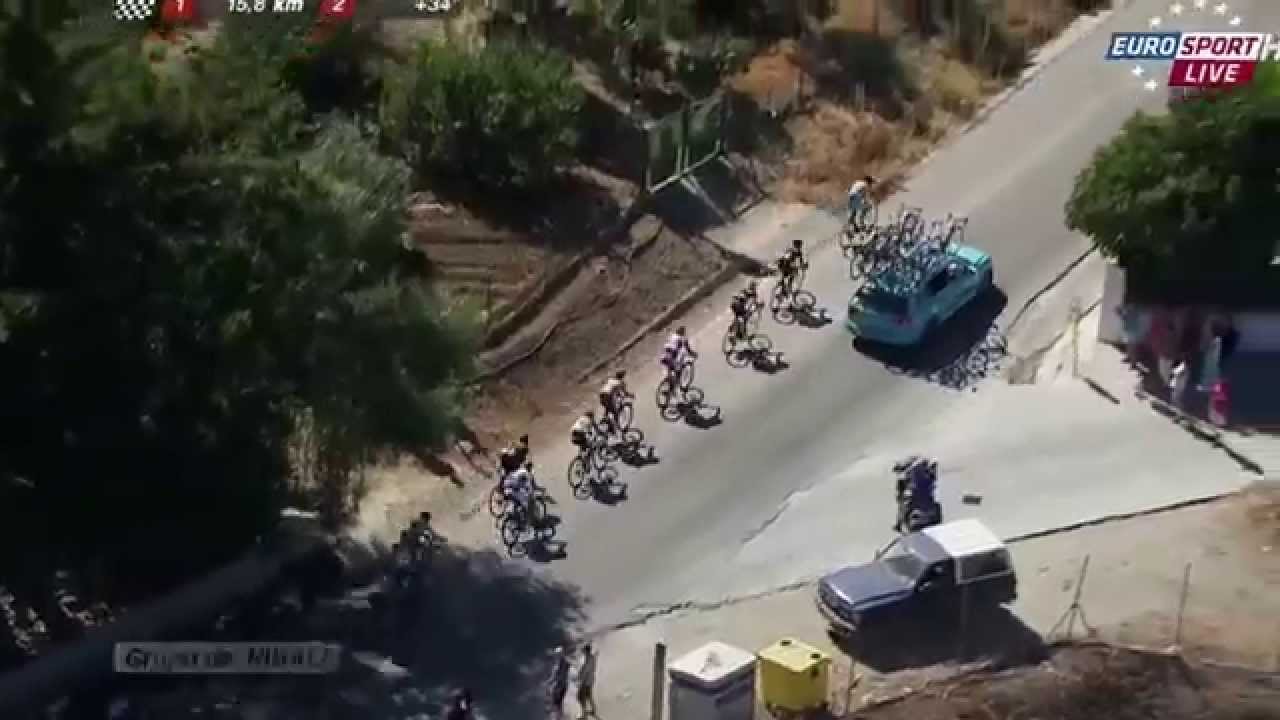
When a rider goes back to a team car to get bidons for themselves or a team mate, someone from the car will hand them a bidon. The rider will grip it, and for a moment neither will let go. This allows the rider to stop pedalling and not lose any speed. They will often pull themselves forward from the bottle too. If they hold on for too long though, they risk getting fined. One infamous example of a rider using a sticky bottle to cheat was Vincenzo Nibali at the Vuelta a Espana (below).
Souplesse
Another French word, the literal translation of which is 'flexibility'. In a cycling context it refers to an effortless, yet powerful pedalling action. It suggests a rider in form, or one that had a particularly stylish and effective style of riding.
