




'The key is remembering it’s not PlayStation – riders don’t always have perfect legs': Adam Blythe talks commentary, style and TV subscriptions
The former pro turned pundit takes on our new Q&A series, Out of the Saddle


Adam Blythe, 36, was born in Sheffield and raced from a young age with Sheffield Phoenix club. He enjoyed a decade-long professional career from 2010 to 2019, earning a reputation for his sprinting strength, sharp tactics and infectious personality. Racing for top teams including BMC Racing Team, Orica–GreenEdge, Tinkoff and Lotto-Soudal, he claimed standout victories including the 2014 RideLondon-Surrey Classic and the road race at the 2016 British National Road Race Championships.
Since retiring, Blythe has brought the same energy and insight to the commentary box, becoming a familiar face and voice for Eurosport and TNT Sports. Now, with his trademark humour and honesty, he reflects on life after racing, the pressures of punditry, and why cycling needs more flair, fun and individuality – on and off the bike.
You were recently involved in a PR stunt where you were on a horse while jockey Harry Skelton was on a bike. How did that come about?
I’d never really been around horses. So I went down to Harry Skelton’s place, his house and stables, where he’s got about 200 thoroughbred racehorses. Just before I left, I said, “Can I at least sit on one?” They’re such big, powerful animals. I was bricking it a bit – more a mental challenge than anything else – but it was a great experience.
You wanted to compare the two worlds, cycling and horse racing?
Exactly. Harry’s really into cycling, so he invited me down to see how their world works, and to compare it. It was eye-opening – there’s a lot more that goes into horse racing than I realised.

You retired a few years ago. How did you find the transition from pro racing into media?
Different – but in a good way. I loved bike racing, but in my last year as a pro I had a lot going on. I already had a little boy at home, then we had twin girls. That was a challenge in itself, and I had to focus on my personal life. By March of that final season [2019] I’d already decided I was going to stop. I was going through a whirlwind of troubles, really, so I didn’t enjoy that last year much.
Moving into media was great. I still get to travel, but I also get to spend proper time at home with my family, which is what I wanted. I still love talking about racing and being involved, just in a different way now.
With a bit of distance from it, what do you miss about life in the peloton?
Honestly, I left at the right time. The sport was becoming more about marginal gains – power, nutrition, numbers – and less about the tactical side that I loved. I don’t miss the process – training every day, getting your head kicked in by the peloton – but I do miss being in top condition, when you could play with a race a little and really enjoy it. Those moments when you had super legs; that’s when racing was fun.
Sometimes when I’m commentating, I look at a situation and think, ‘God, I’d love to be in that right now, to read it, to play with it, to have the legs to make a move.’ But the day-to-day grind – the buses, the team meetings, the suffering – I don’t miss that at all.
You’ve built a really distinctive on-screen and commentary presence. Was that always the plan?
It kind of evolved. I did a little bit while I was still racing, some co-commentary here and there, which I enjoyed. When I stopped, I knew I wanted to do more. I contacted Eurosport straight away and said, “I want to do this.” It took two or three years before I was really on screen full-time. Now I absolutely love it.
“I STILL LOVE TALKING ABOUT RACING AND BEING INVOLVED”
You come across very naturally. Is that just you, or did you have to work at it?
I think it’s natural. For me, it’s about dissecting a race, not just saying the obvious things. You’ve got to imagine you’re the strongest rider in the peloton and think through what options are available, then explain why something didn’t happen, or why someone didn’t make a move. The key is remembering it’s not PlayStation – riders don’t always have perfect legs. I like highlighting those nuances and trying to educate the viewers a bit.
Another part of your persona and reputation is your flamboyant style: the kit, the clothes, the gold bikes. Has that always been part of who you are?
Yeah, I’ve always loved that side. I grew up wanting to look like [Belgian] Iljo Keisse on the track with his white and gold bikes, and on the road you had Italians [Mario] Cipollini, [Paolo] Bettini, [Alessandro] Petacchi – riders with a bit of flamboyance. Back then, between 2000 and about 2015, you could still project your character with little touches of individuality. Now, pro cycling is much more uniform – same bikes, same bars, white shoes, black socks. It’s very slick, but there’s less individuality. When I retired, Genesis let me go wild with bike designs, which was brilliant.
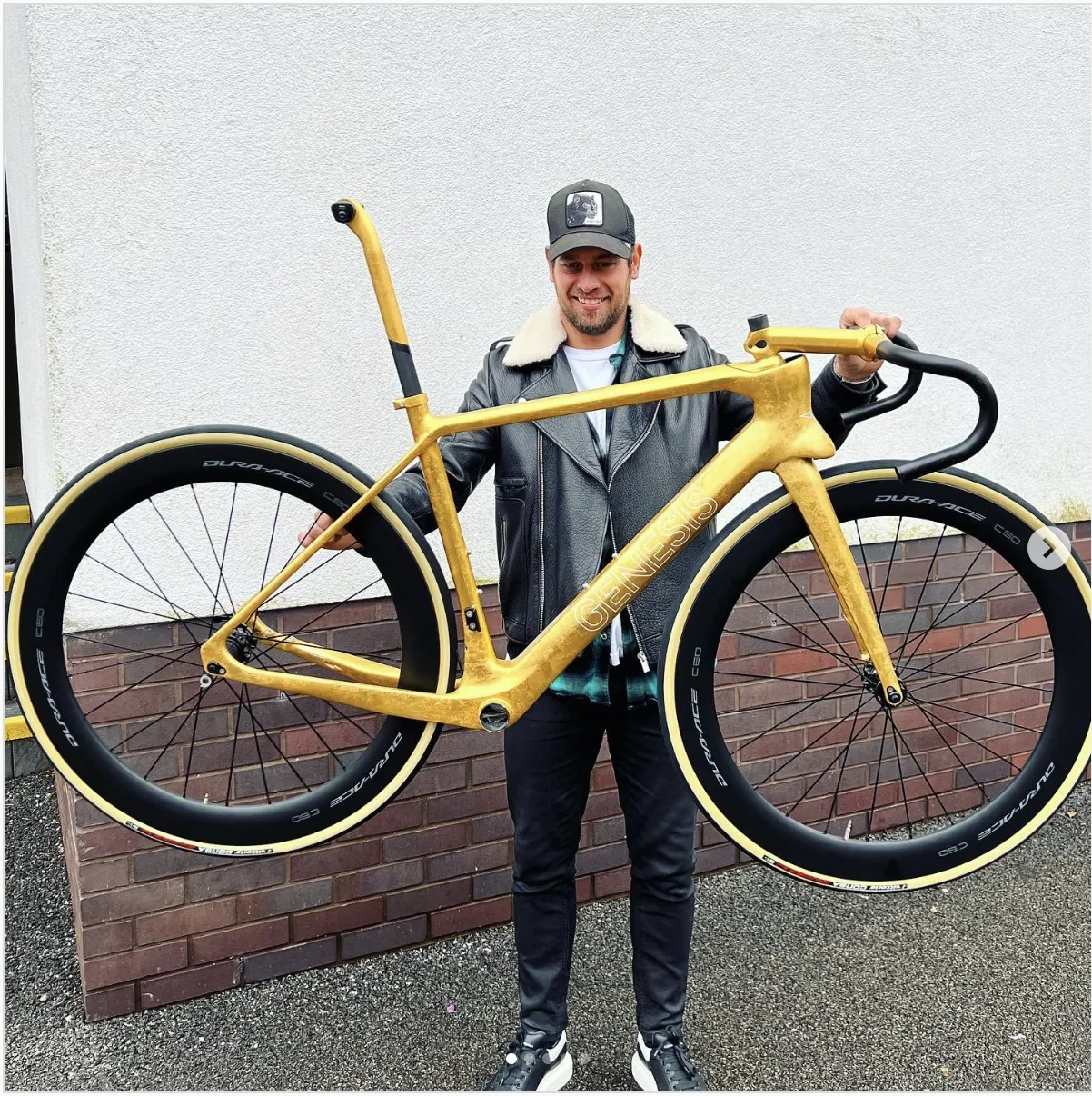
Were you criticised for challenging cycling’s traditional image?
Maybe from people who didn’t know me. They’d see a gold bike and think, ‘That’s awful.’ But people who knew me got it – it was just me expressing myself. Same with my clothes: not everyone likes what you wear, but if you feel good in it, that’s all that matters.
“WHEN CONTRACTS ARE UP, IT’S EVERY MAN FOR HIMSELF”

Have you done any collabs with brands on fashion or kit design?
A little bit, here and there. I’d love to do more of that. I think cycling clothing could be simple, but with a little detail that stands out. I’ve worked with [fashion brand] Reiss recently, in their Richmond store; I love that side of things. I love clothes and using them to express who I am.
Looking at the pro peloton now, what’s changed since you started?
Nutrition has changed massively – fuelling strategies, training methods – and that’s made the racing faster and more exciting. I think that’s a positive. The downside is the lack of individuality. Teams are stricter about everything: interviews, kit, what you can wear. You spend 99% of your life as a bike rider on the bike, and it’d be nice if you could still project your personality a bit more. Even small things – white handlebar tape, different stems – details that might seem trivial, but they make you feel good, sharper, more confident, like putting on a suit.
Do you think cycling struggles to attract youngsters into the sport?
I think, in terms of TV coverage, cycling is in a very good place right now. With TNT, for example, you can watch more cycling today than ever before. People sometimes forget that TNT has to pay a lot for the rights to those broadcasts. When criticism came out about ‘making people pay’ last year, it was directed at us, but actually, ITV didn’t even bid for events like the Tour de France Femmes. TNT were the only ones investing in putting it on TV at all.
Some fans say £30.99 a month, amid a cost of living crisis, is too big an expense just to watch cycling.
It isn’t the cheapest subscription in the world, but it’s no different to football or boxing – you pay to watch those sports too. For years cycling [coverage] was cheap, even free on demand, but the reality is the feed costs money, and without investment it simply wouldn’t be on TV. At least now it’s there, and [TNT] are the ones keeping it on air. If we stepped back, there would be nothing.

What about accessibility? How easy is it for kids to get into the sport?
That’s where cycling is very different from sports like football or basketball with their pitches and courts. Cycling doesn’t have that central facility. Sure, there are velodromes, but first you need a bike, which isn’t cheap, even if second-hand. There isn’t really a [talent identification] pathway, unless you’re already racing, or maybe posting big numbers on Strava. For young people who haven’t got into it yet, it’s difficult. I’d love to see a clearer pathway – something that teaches not just the physical side but also tactics, handling skills, and even the business element of pro cycling.
At the moment, it’s very much: ‘Can you do 500 watts? If yes, we’ll sign you.’ There’s so much more to the sport than that.
You touched on the business side – is it important that riders understand it?
Hugely. Pro cycling is a business, just like any other. You’re effectively a freelancer: you sign a contract, do a job, and if you don’t deliver, you might be out at the end of that contract. People talk about ‘bands of brothers’ and ‘wolf packs’, which sounds great, but when contracts are up, it’s every man for himself. That’s the reality.

Do you think cycling could learn from other sports in terms of national infrastructure?
Definitely. In football, you’ve got academies and stadiums where kids are picked up and developed. In cycling, there’s no single place where that happens. Velodromes are great, but road racing is different, and you’ve got mountain biking, cyclo-cross, time trialling. I think there’s a huge opportunity to create a structure where youngsters can learn across disciplines in one place, but right now it doesn’t exist.
Are we going to see you on horseback again?
Definitely not full-time [laughs]. I wouldn’t say no if I was being properly looked after, but those racehorses, they’re big, powerful creatures. If one of them decides to do its own thing, you’ve got no chance.
Series 2 of ‘Champions: Full Gallop’, featuring Adam Blythe, is available to watch on ITVX.
This interview was originally published in the 20 November 2025 print edition of Cycling Weekly magazine – available to buy on the newsstand every Thursday (UK only) while digital versions are available on Apple News and Readly. Subscriptions through Magazine's Direct.
