Best bike computers 2026: Expert-rated bike computers for navigation and training
Six expert-rated best cycling computers to enhance your ride - aiding you to explore and train with pro-level tools right at your fingertips


Based on 2026 trends, we are now testing computers from the Chinese brand Magene, with full reviews coming soon. We will also have a full and in-depth review of the Garmin Edge 1050 this summer.
The best bike computers now pack a lot of power and are loaded with features beyond just tracking your ride, with some approaching the capabilities of a smartphone. They can amass vast amounts of data about your ride to be analysed on the move or at home.
There is a shift happening in the now-vast bike computer market, with brands like Garmin and Wahoo facing increased competition, not just from Western-tech brands like our top-rated bike computer from SRAM-owned Hammerhead Karoo. Its large touchscreen, user-friendly operating system, new app and navigation make it such a joy to use.
Big Chinese manufacturers have entered the pro-peloton in a big way in 2026, with all sorts of things, including bikes and, of course, tech. Brands like Magene are supporting XDS Astana, and are already well established for making some of the best power meters, alongside IGPSport with Groupama-FDJ. While you won't see any of these units in this guide just yet, full reviews are on the way imminently.
In the meantime, our experts have selected six of the best and latest bike computers, based on our testing, packed with features and technology for you to consider.
The Quick List

With sleek design, an incredibly user-friendly platform and some of the best mapping on the market, it is hard to ignore Hammerhead's continued development and ability to disrupt the stranglehold Garmin and Wahoo have on the market.

If you are looking to keep things simple, with your bike computer tracking your ride and offering decent navigation, look no further than the fuss-free Beeline Velo 2. It is easy to use and follow, but it is also incredible value.

After a complete overhaul of their computer lineup, Wahoo has managed to uphold the Elemnt Bolt's dynasty as one of the best budget bike computers by packing a lot of performance into a relatively small package.

The Edge 850 is exceptionally refined, both in terms of design and thanks to Garmin's user experience. What makes it stand out now, versus the likes of Wahoo, is that the 800 series now features the Edge 1050's vivid colour display.

Garmin’s Edge 1040 Solar, like all Garmin units, offers an impressive range of features. There’s also the solar charging, which doesn't feature on the newer 850/1050 units.

With seemingly infinite battery life, the Coros Dura claims 120 hours of charge, which can be replenished using solar energy at two hours for every one used. Coros has caused quite a stir with this one.
Our experts top picks: The best cycling computers 2026
Best overall

Reviewed by Anne Marije-Rook - North American Editor
The Karoo's predecessor, the Karoo 2, had gained a pretty loyal following in recent years thanks to its excellent display, open-source navigation and an Apple-like commitment to software updates. Could the latest version address some of the minor issues of the previous model, but continue to dispute Garmin and Wahoo's stronghold on the bike computer market?
The short answer is yes: the Hammerhead Karoo takes everything that was great about the Karoo 2 and, with an incremental improvement approach, has made something even better.
A big part of this improvement comes in the form of Hammerhead's new companion app, which effectively completes the ecosystem. It offers users a more seamless experience, as well as an easy way to plan and review routes, view current and previous data, and track live.
One area Hammerhead still struggles against its competitors, and especially with Coros making enormous strides in this area, is the battery life. All I put this down to is that the amazing processing power and performance of this computer is understandably energy-sapping. However, this was an issue with the previous model as well, and one Hammerhead does claim to have improved. I am inclined to agree, as previously it was as low as 7 hours, and now I was with every trick I know to conserve battery to get 10 hours. While this will likely be enough for most, it is still only one, or at most two, weekend rides, compared to my beloved Garmin Edge 540 Solar, which manages nearly two days.
That said, it is still my favourite bike computer and retains its best overall status.
- Read our full Hammerhead Karoo review
Best Budget bike computer

Probably the only bike computer I have ever called 'cute'
Reviewed by Hannah Bussey - Tech Writer
I find myself increasingly being put off by tech, call it age, call it just the vast amount of it in our lives, but for a Cycling Tech Writer, it is very much an oxymoron. I have always thought there was a gap in the market for those who don't really need training aids but like to track rides and need some simple navigation.
Enter the Beeline Velo 2!
This compact and light 28g/08oz device is not much wider than most modern stem top caps, yet despite that, it seems to catch the eye of anyone near my bike. The Beeline is incredibly simple to use and set up, while the first time around, I clumsily got it running (I should have just watched the tutorial first), it became a breeze to get routes from Komoot and Strava.
While my distance perception is not the best, the Beeline gives you plenty of warning of turns, with on-screen and sound alerts. I also used the app's navigation feature, which is very similar to Google Maps, to navigate to a cafe in a town in the southern German Black Forest, without taking a single wrong turn. So, even on-the-fly changes to your route or spotting a POI are not an issue and require very little input from the user.
Aside from the main focus of navigation, you get screens for time, distance to your destination, speed (miles or kilometres per hour), a stopwatch, both devices' battery levels, hill/ climb stats and an End or Stop screen to end the route. I found that, really, the only slight disappointment was the battery life, with the best I got being around 7-8 hours. Which, given the Velo 2's sizes, isn't bad at all.
All said and done, I was able to easily navigate a 60-mile route in the Black Forest and then head straight into the city without ever getting lost and not once did I miss any performance stats or feel I needed more.
- Read our full Beeline Velo 2 review
Best value bike computer

Reviewed by Andy Turner - CW Tech Contributor
We are big fans of Wahoo's cycle computers for their ease of setup and bombproof software, and the Elemnt Bolt V2 was a big favourite of the Cycling Weekly team.
However, Wahoo underwent a complete overhaul of its bike computers in 2025, and you might be forgiven for thinking that the smallest and cheapest of the lot, the new Wahoo Elemnt Bolt V3, would be a bit of a let-down compared to the larger Ace and Roam V3. However, that is certainly not the case.
The Wahoo Elemnt Bolt has become somewhat synonymous with race computers, given its small size and initial design with claimed aero benefits. It’s what Tadej Pogacar has been racing with. Interestingly, the V3 update is slightly larger and heavier than the V2. Although a taller 2.3-inch screen, with an anti-glare coating, and a narrower profile help deliver a better screen experience, even if the light indicators across the top have gone.
It features the same three base buttons, a side power button, and two side zoom buttons. However, rather than the Elemnt app, everything has migrated to the Wahoo app. It’s still ironing out some bugs, but so far, workout scheduling and mapping via Strava routes have worked well.
Having switched from Garmin to Wahoo, I really enjoy the UI, and the ability to zoom in and out of screens to change the number of data fields visible on the fly is something I really like. It also boasts a solid battery life, easily managing 10 hours with multiple sensors connected and 15 hours at maximum capacity. It’s not cheap, but it is more affordable than even older Garmins like the Edge 540, and it packs a large performance punch for such a small package.
Best Garmin bike computer
Reviewed by Aaron Borril - Tech Writer
Like its pricer sibling, the Edge 1050, the Garmin Edge 850’s most prominent feature is, without a doubt, the new display, which is now brighter and crisper than before. The new and improved display, however, comes at the expense of battery life, which is now claimed to be 12 hours - although Garmin says this figure was measured in “demanding use”, and users are likely to achieve better usage depending on the features they prioritise. Still, when comparing it to its nearest rivals, such as the Wahoo Elemnt Roam 3 with its 25-hour battery life, the Edge 850 appears to represent a step backwards. Where’s the solar tech that made the Edge 840 such a tremendous hit among users?
The Edge 850, however, is super refined - both in terms of design and the user experience. Garmin has crafted one of the best interfaces in the segment, which is intuitive and easy to use. Current and new users will have no issues setting up personalised screens, and the entire computer, like all Edge devices, syncs with the GarminConnect for the most holistic connected experience in the segment. Like most options available, it finally gets a bell feature, and the real-time traffic and pothole warnings are a clever and appreciated new addition.
Unlike its predecessor, the Edge 840, there is no solar option at present, but this might change in the future. While its rivals have closed the gap, particularly in terms of battery capacity, the Garmin Edge 850 still represents the pinnacle of medium-sized premium cycling computers with the most refined and polished in the game - it’s rapid in its response to user input, the touchscreen is phenomenal, with no lag, bugs/glitches.
- Read our full Garmin Edge 850 bike computer review
Best for training

Reviewed by Stefan Abram - Previous Tech Writer
The ability to charge the Edge 1040 Solar via the sun is quite the attention grabber. Garmin says the Power Glass™ solar charging extends battery life up to 42 minutes per hour in battery saver mode, giving you up to 45 hours of battery life in what it describes as "demanding use cases" and up to 100 hours in battery saver mode.
It's worth noting that this is based on an assumption of continuous 75,000 lux conditions during daytime rides. Essentially, that means consistently bright sunshine that you may well enjoy during summer rides, but, depending on where you live, are less likely to experience during the cooler seasons. Naturally, your expectations should match the amount of cloud cover.
The Garmin Edge 1040 Solar also features a revamped user interface that we found to be far easier to navigate than other Garmin models. The home page features customizable data fields so you can easily scroll through your recent activity history, training schedule, weather forecast and more. You can also view data such as your recovery time using the 'glances' feature.
Other interesting features include the Power Guide, which generates a pacing strategy for your chosen route to help you best manage your efforts. Naturally, all this tech doesn't come cheap, but if you're after an all-singing, all-dancing cycling computer you're unlikely to be disappointed.
- Read our full Garmin Edge 1040 Solar review
Best battery life

Boasting 120 hours on a single charge without the Solar topup, will you ever need to charge it?
Reviewed by Anne Marije-Rook - North American Editor
I received my test unit only a short time before the launch, which gave me limited time with the Coros. Initial impressions are that the unit is small, super light and thin. Up against a Garmin Edge 1040 and Hammerhead Karoo, considering the claimed battery life, it's a similar size to both, which is impressive.
The 'crown' similar to a watch winder (Which is what Coros is known for) might be a welcome sight for those needing to ride with thick gloves in winter, allowing you to navigate settings and pages.
I did experience a few hiccups in the first few rides, largely due to many features not being available until public launch time. I am told by Coros that a lot of these have updates coming or are already fixed. This could be put down to a lack of familiarity with the new ecosystem. Unlike Garmin and Wahoo, a lot of the Dura's settings need to be set within the app rather than on the device itself.
Let us get to that battery life. After a week's riding, including a big eight-hour-long backcountry ride, I still had 70% battery left. When I first spotted the Coros at Unbound, Haley Smith said: "I have yet to charge the unit since receiving it at the Sea Otter Classic – 90 hours of riding time and counting". Time will tell truly how long the battery will last, but initial impressions look good.
- Read our full Coros Dura bike computer review
How we test
Cycling Weekly has a team of testers with vast experience in testing bikes, components, clothing and accessories across a wide range of prices and spec levels, so they know bikes and tech inside out and have the experience to know what makes a great cycling product.
Our experience means that you'll have a consistent, in-depth viewpoint, which is reflected in our product scoring. You can find out more on our How We Test page.
When it comes to testing the best bike computers, we log plenty of miles both outdoors and on the turbo to assess their performance. We take into consideration a range of factors, including how easy they are to set up and use and the variety of functions they offer, both as navigational and training tools, as well as practical considerations like battery life, charge time, resistance to weather and of course value for money.
For more buying advice in cycling, be sure to have a read of our guides on the best bike lights, best road bike helmets, and best exercise bikes.
Meet our testers

With the volume of kilometres and training Rook puts in on the bike, she needs multiple tools to keep track of all that data. Of which only the best bike computers can handle. Tracking just how many bikes Rook owns is more than most tools can handle, before you even get to some of the bonkers and epic rides she now chooses 'for fun' to take part.

Hannah maybe retired from full time racing and the pro womens peloton, however, don't let the 'Mom life' foul you. Hannah still puts in the time, maintaining her numbers and training with the best bike computers. Even if she is now on the other side of the tape screaming encouragement at the next generation of Bussey to take the startline.

Like Rook, Aaron is a prolific rider; however, he is still at the top of the sport, representing his country as an esports athlete and going on the likes of Tom Pidcock at Gravel Burn. That is why Aaron needs access to the latest, best bike computers to ensure his training and data are on point.
Frequently asked questions about bike computers
What features can I expect from an entry level non-GPS cycling computer?
The most basic cycle computers are generally available for about the cost of a takeout lunch, (or even cheaper if you do a bit of shopping around). Of course, for this sort of money your computer isn't going to be packed full of functionality.
The very cheapest bike computers will measure the basics such as your speed and cadence (and from these calculate things like your average speed and average cadence), taking these figures from speed and cadence sensors located on the bike frame, to which they are connected using wires.
Pay a little bit more, and you can upgrade to a wireless cycling computer, which will connect to your speed and cadence sensors without the need for having unsightly wires running all over your frame. These sorts of computers are probably the best option if you're on a budget and aren't worried about uploading your rides to Strava or doing any serious, structured training.
In general, just less than a triple-figure price tag will give you even more choice cycling computer-wise, and they will begin to offer more functionality, although in general, unless you get one of a deal, it's unlikely that these models will go quite as far as being a true GPS enabled unit.
What features can I expect from entry level GPS cycling computers?
An entry-level GPS unit will be great for getting you going with tracking your rides, and possibly other features. You can often find bundle deals with a heart rate monitor and/or cadence sensor, which might push the price up slightly, but work out more cost-effective than buying items separately.
At this price point, manufacturers prioritize ease of use, small size and low weight – usually well below 3.5oz/ 100g.
The GPS unit will typically track your ride statistics such as distance, time, speed and lap times but will not provide navigation. Most units will pause automatically when you stop moving and resume when you restart and provide ANT+ connectivity for external sensors.
Ride data is typically displayed in two or three rows on a black and white screen. There may be the option to specify which data items and how many rows are displayed, but one of the selling points of these devices is that you turn them on and start cycling without needing to delve into complex configuration options, so personalization tends not to be a priority.
The GPS may also allow you to set alerts when you have reached a target value such as having ridden for a pre-specified time. You can get virtual competitor functions so that you can see how well you are doing compared to previous rides of the same route.

The Bryton Rider 40 is a mid-range unit emphasising training plans
What features will I find on a mid-range GPS cycling computer?
Spend a bit more and you will start to get additional functionality in your GPS. Mid-level units can often come bundled in with a heart rate monitor or cadence sensor, but will also have a high level of compatibility, so will be capable of displaying and tracking data from existing hardware you have, including any power data.
A mid-range unit will usually be larger with a bigger screen which can display more data, often in color. Data storage capacity will probably also increase. The unit may be controlled by buttons or a touchscreen, and many mid-range units add mapping and navigation functionality. Some will have basemaps preinstalled, or that can be downloaded while others may only support breadcrumb trails.
Because of how GPS satellite triangulation works, altitude data calculated from GPS is less accurate than positional data. Thus higher-spec units will often add a barometric altimeter to increase recording accuracy for height and rate of ascent.
Many mid-range units now include Bluetooth synchronization to a smartphone, meaning your computer will show you calls and texts on screen, and other data from the phone, such as weather alerts. Some computers send data back to the phone, so it can transmit ride progress data to the internet, where people you allow can view it, and let you upload your rides without the need for a USB cable.
What features can I expect to find on a high-end GPS bike computer?
The arms race in high-end cycle computers continues and manufacturers seem to be announcing new top-of-the-range features every few months. These products come in at almost half the price of a decent road bike or more, weigh up to 7oz/ 200g and may come packaged with a heart rate monitor strap and a cadence sensor.
At this price point, you should expect a color touchscreen, mapping, turn-by-turn navigation, and advanced training features and integration. This may include WiFi connectivity for data transfer, route suggestions, and the ability to share a route with your ride companions.
These higher-end computers are likely to have integration with other devices and applications. Most will connect to electronic drivetrains for gear information, show Strava Live Segments and allow for workouts to be synced directly from third-party apps like TrainingPeaks or Today's Plan.
There was a time when battery life was an issue on these computers with their large screens, but now you can expect about 20-hours of run time. These higher-end units will all have access to multiple positional satellite constellations like the Russian GLONASS, Chinese BeiDou, and the EU's Galileo network.

The more expensive GPS computers will offer turn-by-turn navigation and a host of other features.
How can I use a bike computer to analyze my ride data?
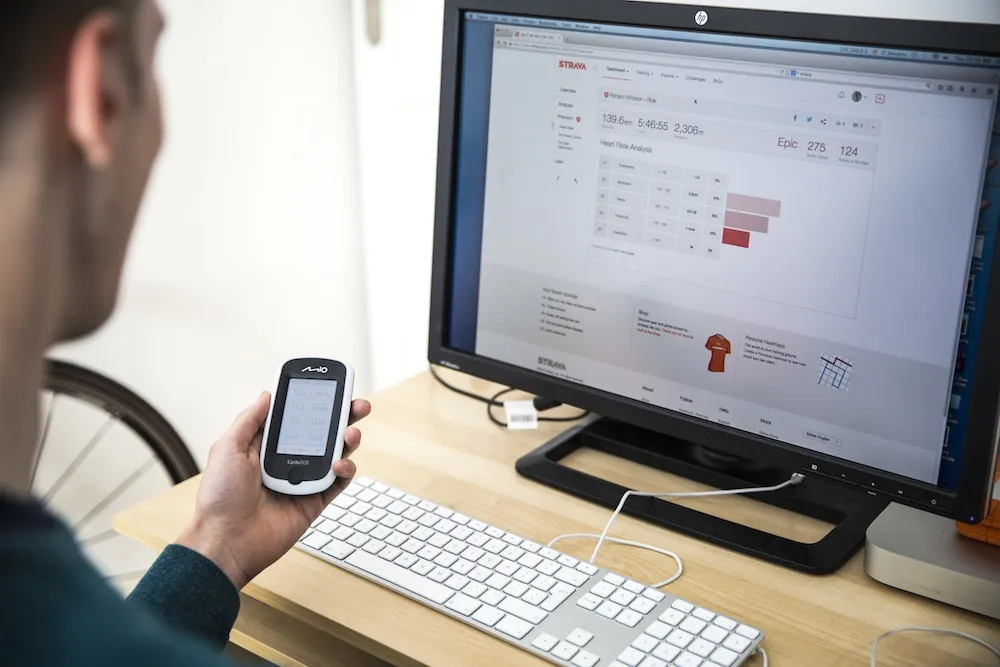
Even basic cycling GPS units allow you to download data post-ride to the manufacturer’s ride recording site and phone app. These apps support ride analysis, training plans and social interaction, although the quality of the functionality and user interface varies. But you can then upload your data to Strava, Training Peaks or other third-party sites if the manufacturer's site falls short.
Analysis options will be richer, of course, if you have used peripheral devices such as a cadence sensor or power meter to capture extra data.

Manufacturers' ride analysis apps provide mapping and ride statistics
What are the best alternatives to a cycling computer?
If you don’t want to buy a cycling-specific GPS, other options are available. Modern smartphones will have a GPS chip built into them. This may not be as precise as the chip in a dedicated cycling GPS but should still allow you to track your position with reasonable accuracy. You can log your rides using a smartphone app like Strava, with the best smartphone apps offering much of the functionality of a basic computer.
You can either put your phone in a pocket or buy a phone mount that attaches to your bars or stem, like a Quadlock or Rokform phone mount. Both are good examples of how to mount your phone on the handlebars safely.
If you use your phone beware of water, as many are not water-resistant. Battery life may be an issue too, especially if you want to use your phone’s display to see your data while you ride.
If you are going to carry your phone, another option is to use its GPS capability to collect ride data, which is transmitted via Bluetooth to a bar-mounted display unit, like the Cateye Padrone.
This allows you to keep your phone out of the way and turn off the screen whilst still being able to see ride statistics. Display units will usually also show data collected from peripheral devices via ANT or Bluetooth.
GPS-enabled sports watches are also popular among triathletes and mountain bikers. Our page on the best smartwatches for cycling gives you the full lowdown on wearable fitness trackers that are great when riding.
These allow you to track activity across different sports and many allow connection to peripheral devices and include navigation too. Some come with a bar mount so that you can use the watch attached to the bike or on your wrist.